Quick Links
Contact Us
Borak Unique Heights, Eskaton Garden, 117 Kazi Nazrul Islam Ave, Dhaka 1217

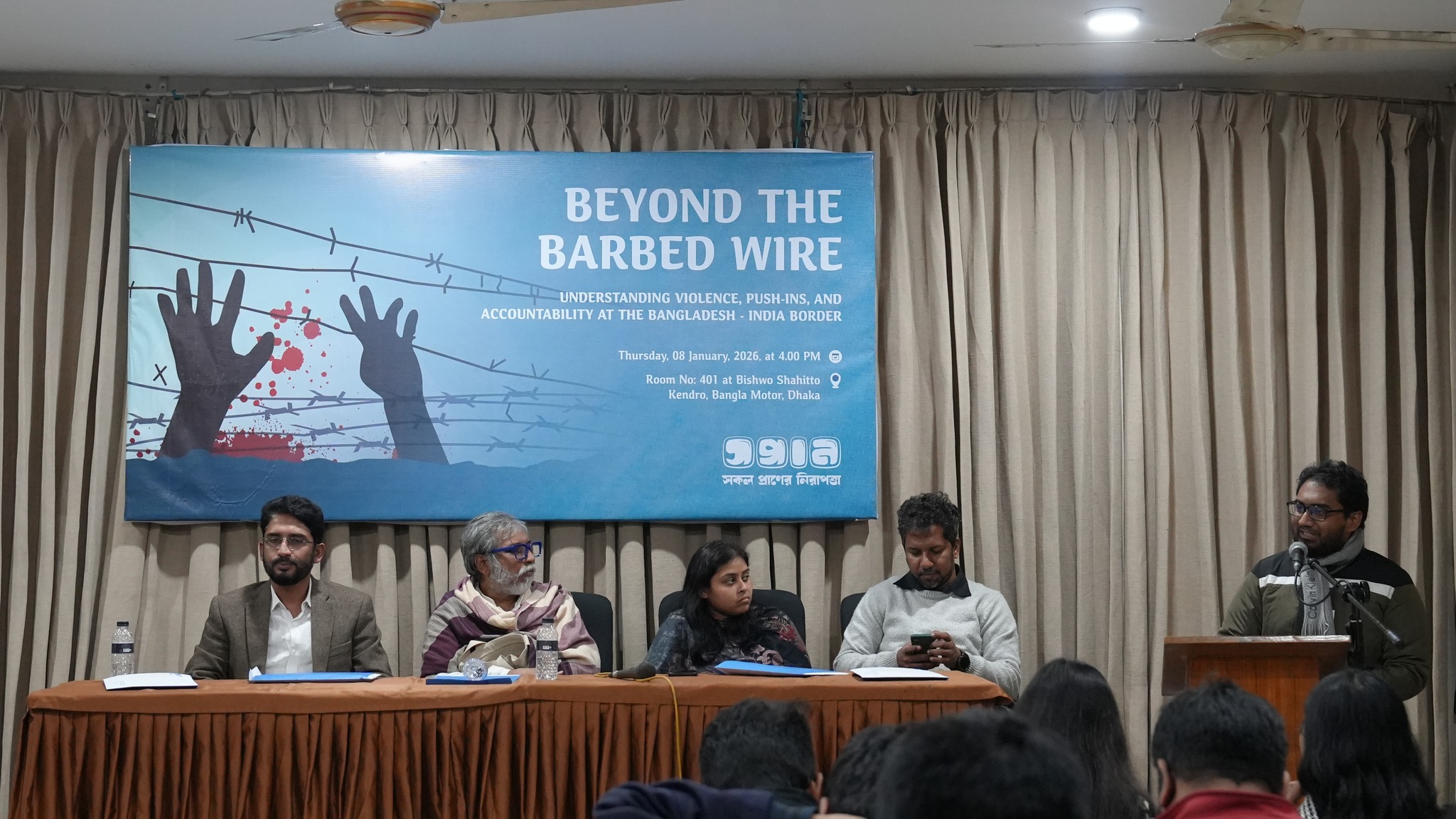
Beyond the Barbed Wire: Understanding Violence, Push-ins, and Accountability at the Bangladesh–India Border
Room no 401, Bishwo Shahitto Kendro
17 Mymensingh Lane, Banglamotor, Dhaka 1000, Bangladesh
At the seminar, Sapran researcher Nusrat Jahan Nishu presented a summary of the research paper titled "Bare Lives Across the Border: Collective Suffering and Culture of Impunity in the Bangladesh-India Frontier".
She presented statistics on border killings, push-ins, and various crimes, illustrating how life becomes trivialized at the barbed-wire fence. Sapran called for the formation of a collective movement among South Asian civil society to resolve border issues. Additionally, recommendations were made regarding the necessity of economic development in border areas.
The panel featured distinguished academics and human rights professionals:
Dr. Sayeed Ferdous (Pro-Vice Chancellor, Bangladesh Open University and Professor of Anthropology, Jahangirnagar University): He emphasized that South Asian researchers must look beyond Indian perspectives and analyze the border based on the daily realities of border residents, moving outside of formal state and legal frameworks.
Dr. Navine Murshid (Associate Professor of Political Science, Colgate University, USA): She explained how bilateral relations and economic liberalization in the contemporary neoliberal era have effectively abandoned the Bengali Muslim population of India.
Dr. Sajjad Siddiqui (Acting Chairman, Department of Peace and Conflict Studies, Dhaka University): He opined that maintaining internal unity would allow for better bargaining power on border-related issues.
Parvez Ahmed Roni (Team Leader, Photography and Archiving Department, Drik): He presented photographs of the border, documenting daily human rights violations that often go unnoticed by the public. He also highlighted institutional delays and lack of cooperation from Indian authorities regarding the handover of victims' bodies.
Zarin Itu (Documentation Officer, Human Rights Organization 'Odhikar'): Sharing her field experience, she noted that victimized families are still suffering from trauma, which makes them fear demanding justice in the future.
Md. Zarif Rahman, Research Director of Sapran, stated in his closing remarks that the border crisis cannot be tackled through nationalist narratives alone. He remarked that the perception of the border from Dhaka is entirely different for those living in border areas, where the concept of the "state" has been imposed, creating permanent social, economic, and familial scars. He emphasized the need for improving living standards in these areas and called for more in-depth research.
The event was moderated by Sapran researcher Opshora Islam Tondra.
14 February 2025
20 March 2025
10 April 2025